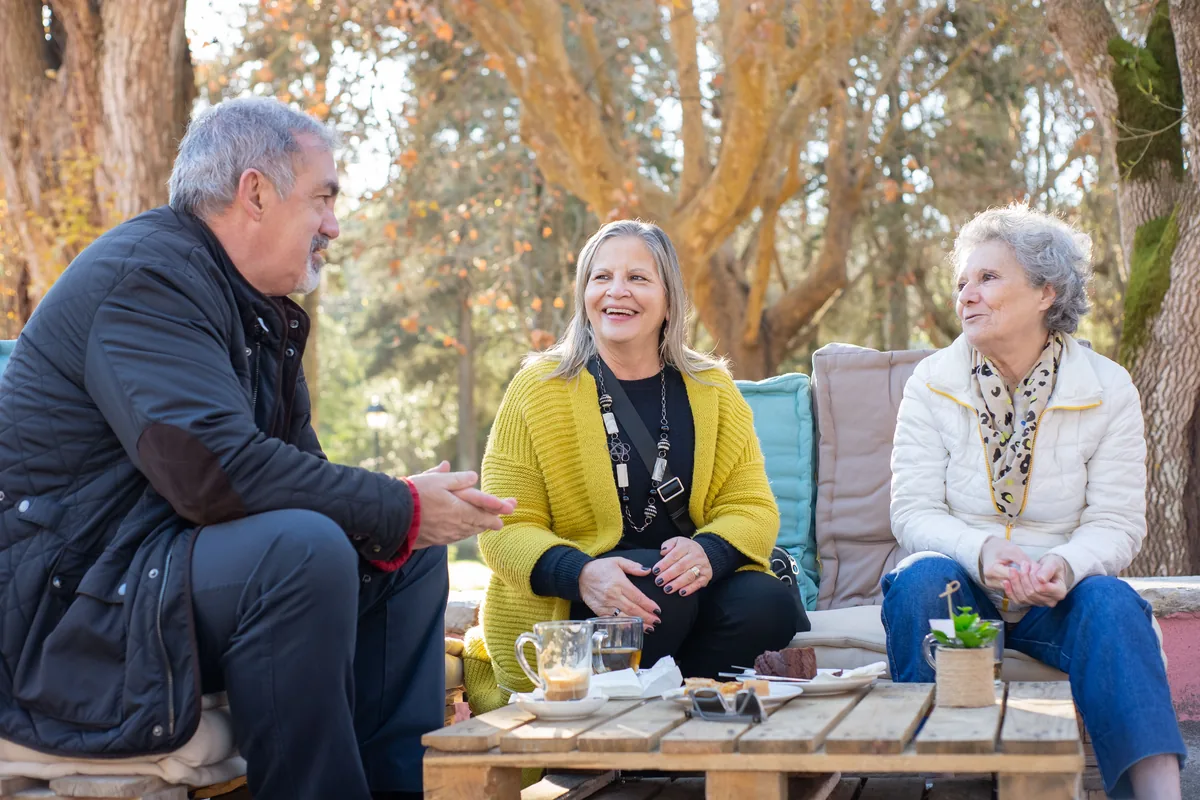
Beating the Winter Blues: Company, Warm Spaces and Connection
24 September 2026 by Luis Salas
The clocks go back on 25 October, and within a fortnight the evenings have swallowed most of the day. For anyone who lives alone, that shift does something specific: the casual, unplanned contact that carries you through the summer, the neighbour in the garden, the walk to the shop, the person on the bench, quietly stops happening. Nothing has gone wrong. The structure has just been removed. 💚
That is worth naming, because winter loneliness is usually treated as a mood when it is closer to a logistics problem.
1. Why winter is different
In summer, a good deal of company arrives without being arranged. You go out because it is pleasant, and you meet people because you are out. Almost none of it goes in a diary.
In winter, that entire layer disappears. Dark, cold and wet afternoons mean the only contact you get is the contact you deliberately organised. If you did not organise any, there is none, and a week can pass with nobody to speak to.
This has nothing to do with being sociable or unsociable, or with how many people care about you. It is arithmetic.
The practical consequence is that winter is the season when connection has to be scheduled rather than left to happen.
Simple action: Look at the coming week. Count the times you will be in the same room as another person. If the answer is none or one, that is the thing to change, and it is changeable.
2. Fix things in the diary before the clocks change
The single most effective step is to arrange the regular commitments now, in the autumn, while it still feels easy.
A weekly or fortnightly fixed thing beats a vague intention every time, because on a wet Tuesday in January the intention loses and the commitment holds. It works best if it is:
- On the same day each week, so it becomes routine rather than a decision
- Somewhere warm, so the venue is not a reason to stay home
- Involving people who will notice if you do not turn up
That last point matters most. Being missed is what gets people out of the door on the days they would rather not.
Libraries, community centres, church halls, U3A groups, choirs, lunch clubs, walking groups and Men's Sheds all run through winter. So does volunteering, which has the advantage of being expected somewhere at a particular time.
💡 Tip: Choose the daytime version of anything you are offered. Evening events in January face a much higher failure rate, and it is not about willingness. Getting home in the dark and the cold is a genuine obstacle, and choosing a 2pm option removes it entirely.
3. Warm spaces
Across the UK there is a network of Warm Welcome spaces: libraries, cafés, community centres and churches that open as warm, free places to sit, with no expectation that you buy anything.
They were set up around energy costs, but the thing people report valuing most is the company rather than the heating. You can find your nearest at Warm Welcome.
Similar schemes run in Ireland and the Netherlands through local councils, libraries and community organisations, usually under local names. Your library is the reliable place to ask, and libraries themselves are warm, free, open all day and require nothing of you.
There is no qualifying test for any of this, and nobody at the door assessing whether you need it enough. A warm room with other people in it is the entire offer.
4. Someone to talk to
If the immediate problem is that days pass without a conversation, there are services built precisely for that, and they are free.
In the UK, the Silver Line Helpline is open 24 hours a day, 365 days a year on 0800 4 70 80 90. You do not need a reason to call, and a good many people ring for a chat at three in the morning when the house is quiet. Age UK also runs a Telephone Friendship Service which matches you with a volunteer for a free weekly call. For advice on anything else, the Age UK Advice Line is 0800 678 1602, 8am to 7pm, every day of the year.
In Ireland, ALONE runs a National Support and Referral Line on 0818 222 024, offering support, advice and practical help, along with a befriending service.
In the Netherlands, de Luisterlijn is on 088 0767 000, available day and night, all year. It is anonymous, they do not see your number, and you can also use their chat service between 10am and 10pm.
💡 Tip: A weekly telephone friendship call is often easier to accept than an invitation to go somewhere, and it does not replace going out so much as make it more likely. Having spoken to someone on Tuesday makes turning up on Thursday feel considerably less like starting from cold.
5. Light, sleep and the difference worth checking
Winter affects mood, and it is not weakness to be affected by it.
Getting daylight early in the day helps more than most things. Even twenty minutes outdoors in the morning, on an overcast day, delivers far more light than an indoor room. Wrapping up and going out before lunch is worth more than the same walk at dusk.
Keeping your sleep and mealtimes steady matters too. Long dark evenings pull bedtimes and getting-up times apart, and that drift makes everything else harder.
There is a point, though, where this stops being the winter blues. If low mood persists for weeks, if you have lost interest in things you normally enjoy, if you are sleeping much more or much less, or if it is affecting how you eat, that is worth taking to a GP. Seasonal affective disorder is a recognised condition and there are treatments for it. It is not something to endure until March out of a sense that everyone finds winter hard.
6. If you are reading this about someone else
A good many people arrive at a guide like this worrying about a parent, a neighbour or a friend rather than themselves.
The most useful thing you can offer is usually specific and small. "I'll come Tuesday at eleven" works. "Let me know if you need anything" almost never does, because it puts the asking on the person least likely to ask.
Regular beats grand. A short phone call every Sunday is worth more over a winter than one long visit at Christmas.
And if you are the one who is lonely, it is worth saying that this is one of the most common experiences there is at this time of year, and one of the least often said out loud. It is not a personal failing, and it is not permanent. It is a dark few months with the usual scaffolding taken away, and scaffolding can be put back. 💛
If today feels difficult, ring one of the numbers above. They exist for exactly this, and you do not need to be in crisis to use them.
For the wider question of rebuilding a social circle, our guide to finding your people after retirement covers where to start, and our guide to dealing with loneliness and isolation goes into it more deeply. If you want something with a bit of purpose attached, our guides to volunteering after 60 in the UK, Ireland and the Netherlands cover how to begin. If cost is part of what keeps you in, our guide to keeping your home warm without overspending may help. Browse more Una guides for plain English help with community and connection.


Get More Guides Like This
Sign up to receive helpful guides and tips delivered to your inbox.
We'll send you helpful content, never spam.